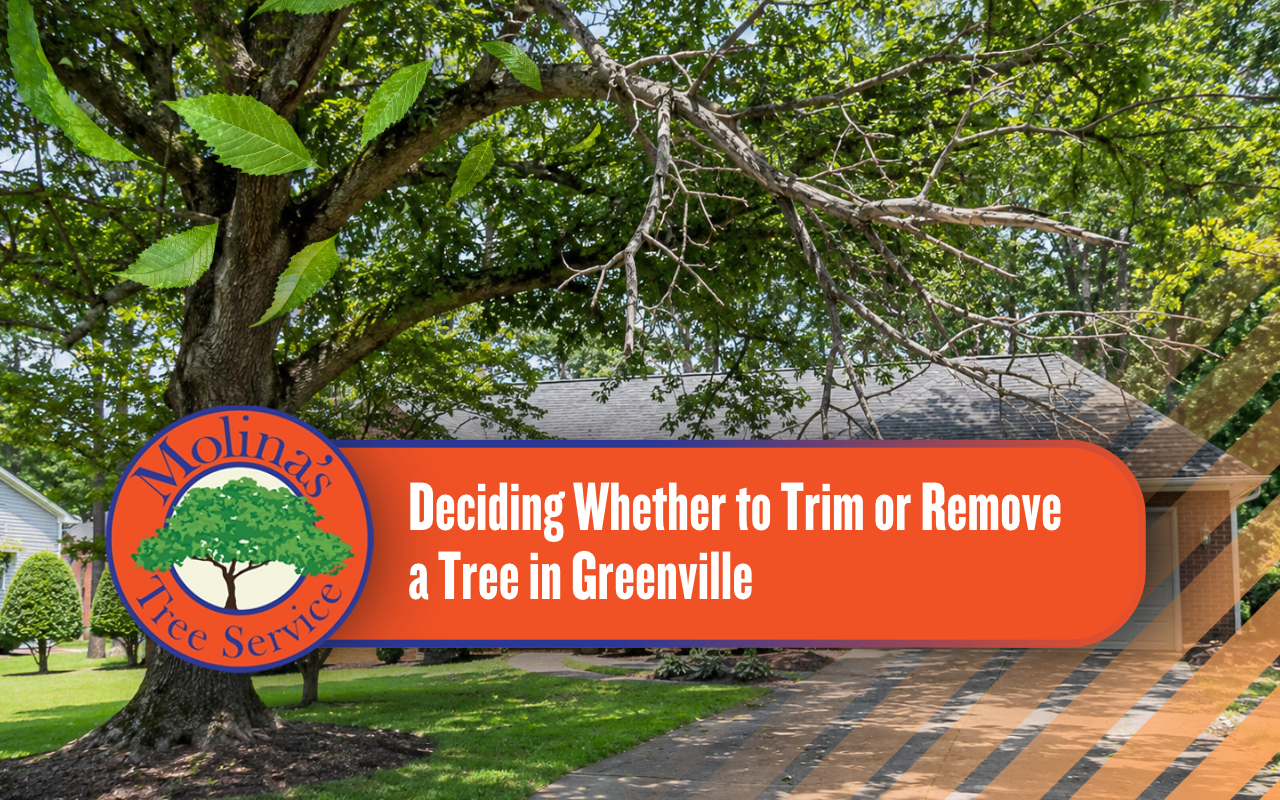
A tree with a few dead limbs over the driveway raises a hard question: is it worth saving, or is it becoming a risk? Many homeowners wait because both choices feel permanent. Most trees give clear clues, and a short inspection usually settles it.
If you want help reading those clues, you can get a second opinion with a free same-day estimate.
Why the Same Tree Damage Can Need Different Answers
Two trees with similar damage can call for opposite decisions. A healthy oak with one broken limb usually recovers well after trimming, while a pine with the same break and a cracked trunk may not. The choice to trim or remove a tree in Greenville depends on health, structure, and what sits underneath.
Location matters as much as condition. A weak tree in an open field is a lower risk than the same tree over a bedroom, a pool, or a neighbor’s fence.
Signs Trimming Can Still Fix the Problem
Trimming is often enough when the trunk is sound and the problem is limited to branches. Look for these signs:
- Dead or broken limbs make up a small part of the crown.
- The trunk has no deep cracks, cavities, or fungus at the base.
- The tree still leafs out evenly in spring.
- Branches only need clearance from the roof, wires, or driveway.
Careful cuts can also improve the tree’s shape for years. Our approach to structural pruning in Greenville shows how we thin and balance a crown.
A Side-by-Side Look at Trimming Versus Removal
The table compares both options so you can match them to your situation. If your tree fits both columns, you can compare trimming and removal during an on-site visit.
| Factor | Trimming makes sense | Removal makes sense |
|---|---|---|
| Trunk condition | Solid, no deep cracks | Split, hollow, or decayed |
| Crown health | Mostly green and full | Large dead sections |
| Lean | Long-term and stable | New or getting worse |
| Roots | Firm in the soil | Lifting, cut, or rotting |
| Location | Room to fall safely | Close to the house or lines |
Scenarios We Often Find Around Greenville Homes
A Pine Leaning Toward the House After a Storm
A new lean with raised soil on one side means the roots have moved. That tree usually needs to come down soon, even if the needles are still green.
An Oak With Deadwood but a Solid Trunk
Deadwood alone is common in older oaks. Removing the dead limbs and checking the trunk is usually enough to keep the tree safe.
A Tree Crowding the Roof and Gutters
Overhanging limbs that drop leaves and scrape shingles can often be cut back. Our Greenville pruning and trimming service handles this kind of clearance.
When Removal Becomes the Safer Long-Term Choice
Some trees have reached the point where trimming would only delay a bigger problem. Removal is usually safer when:
- More than half of the crown is dead or bare.
- A crack runs through the trunk to the inside.
- Mushrooms or soft wood appear at the base or on major roots.
- The tree drops large limbs after each storm.
At Molina’s Tree Service & Landscaping LLC, our fully insured crew removes trees in sections when they stand close to homes. Our page on Greenville tree removal services covers the process.
Upstate Soil, Pests, and Weather That Shape the Decision
Greenville’s red clay holds water after heavy rain and can compact around roots, which weakens some trees over time. Upstate pines can also be stressed by bark beetles, especially after drought or injury, and winter ice storms expose weak limbs quickly.
These conditions do not mean a tree is doomed. They mean an already weak tree may decline faster here, so it is worth checking stressed trees before winter weather arrives.
Mistakes That Make the Decision Harder Later
At Molina’s Tree Service & Landscaping LLC, we have done tree work for more than 12 years, and these patterns come up whenever a decision gets delayed:
- Topping a tree to save it, which leads to weak regrowth.
- Waiting until a storm forces an emergency removal.
- Piling soil or mulch high against the trunk.
- Ignoring fungus at the base because the leaves still look green.
What Happens to the Stump After Removal
Once a tree comes down, the stump can stay, decay slowly, or be ground below the surface. Grinding opens the space for grass, beds, or a new tree. Homeowners who plan to replant often choose stump grinding after removal so roots do not get in the way.
Frequently Asked Questions
Can a tree recover after heavy trimming?
A healthy tree can recover from moderate trimming, but removing too much of the crown at once can weaken it. Most trees do best when less than one-third is removed.
Is a leaning tree always dangerous?
No. A lean that formed slowly over years is often stable. A new lean, especially with lifted soil, is a warning sign.
Do you remove trees for businesses too?
Yes. We work with homes and businesses across the Greenville area.
How soon can someone look at my tree?
We offer free same-day estimates, and for storm damage we provide 24/7 emergency service.
What hours does your crew work?
Our team works Monday through Sunday, from 8:00 am to 6:00 pm.
Choosing the Right Path for Your Greenville Yard
The decision to trim or remove a tree in Greenville gets easier when you look at the trunk, the roots, and what the tree could hit. Trim when the structure is sound, and remove when the damage reaches the core.
At Molina’s Tree Service & Landscaping LLC, we can inspect the tree and explain both options in plain terms. You can book a tree evaluation and plan the next step with confidence.