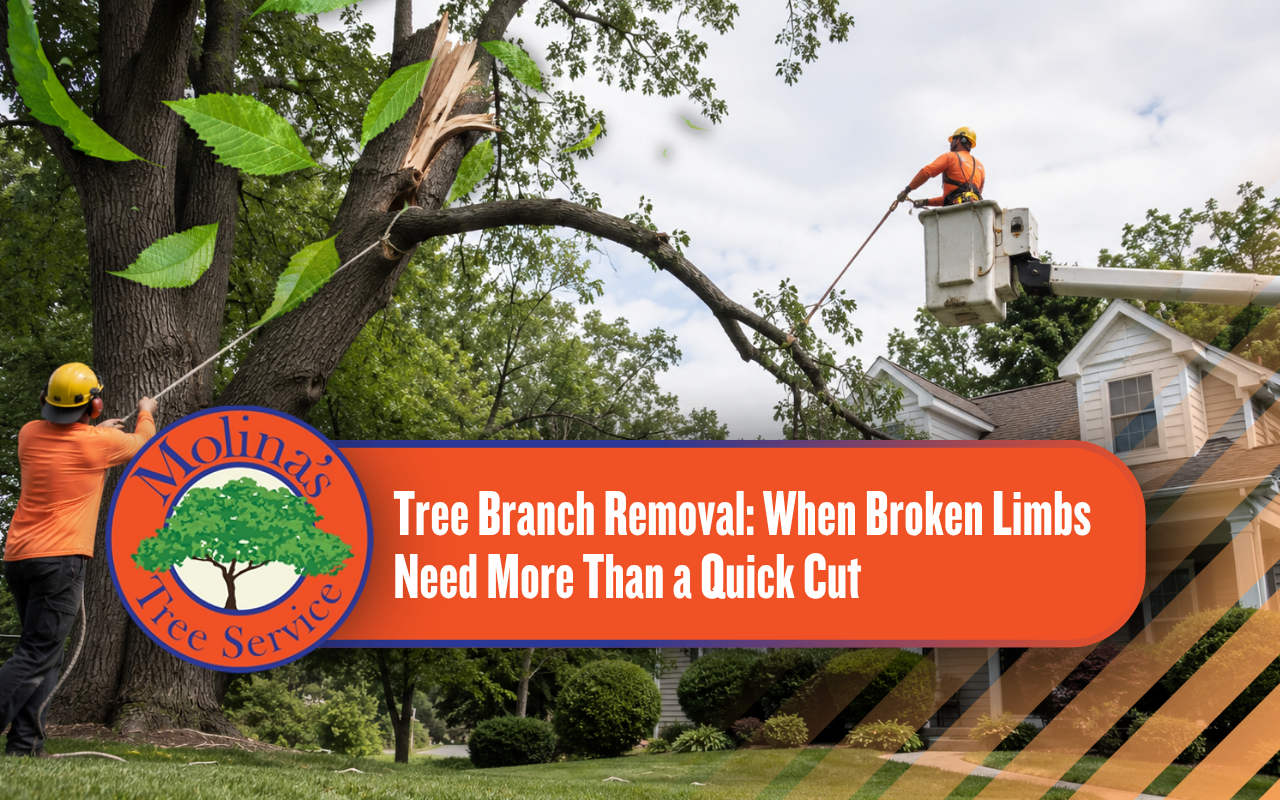
A broken tree limb can hang for days without falling, then drop during the next gust of wind. Branches over roofs, driveways, play areas, and walkways deserve careful attention because their weight and attachment point are not always obvious from the ground.
Schedule professional branch removal with an insured team backed by 12+ years of experience and 24/7 emergency availability.
At Molina’s Tree Service & Landscaping LLC, we help homeowners separate routine trimming from urgent hazard work. The goal is not simply to remove a branch, but to make a cut that protects people, property, and the remaining tree structure.
Which Broken Limbs Need Immediate Attention?
A limb does not have to be on the ground to be dangerous. Hanging branches, split unions, and partially attached limbs can shift without warning.
- Branches resting on the roof
- Limbs hanging over driveways
- Large splits near the trunk
- Storm-damaged branches caught in other limbs
- Cracked limbs above sidewalks or play areas
- Branches touching utility lines
Why the Final Cut Matters
Tree branch removal should preserve the branch collar when appropriate and avoid leaving oversized stubs. Poor cuts can create unnecessary wounds and make future decay more likely.
Our review proper trimming techniques guide explains why saw choice, cut placement, and limb size all affect the result.
Call Before a Hanging Limb Falls
Plan safer storm maintenance if broken branches remain in the canopy after high winds. A limb that is still attached may be under tension, twisted, or supported by another branch, making it difficult to predict how it will move when cut.
Never stand directly beneath a hanging limb or attempt to pull it down with a vehicle. Controlled removal is safer than forcing an unpredictable drop.
Branch Removal vs Tree Removal
| Condition | Branch Removal | Whole Tree Removal |
|---|---|---|
| One broken limb | Often enough | Usually unnecessary |
| Healthy trunk | Often appropriate | Not normally needed |
| Major trunk split | May not solve risk | Evaluation needed |
| Multiple failed leaders | Limited benefit | May be considered |
| Tree uprooted after storm | No | Emergency removal |
Storm Damage Can Hide Above Eye Level
After a thunderstorm, inspect trees from the ground before walking underneath them. Look for fresh pale wood, torn bark, hanging foliage, shifted branches, or a canopy that suddenly looks uneven.
If an entire tree has shifted, our review storm removal options page can help you understand when branch work may no longer be enough.
What About Branches Near Power Lines?
Do not trim or remove branches contacting energized utility lines. Keep people away and contact the utility or an appropriately qualified professional.
Electricity can travel through branches and tools, especially when wood is wet. This is not a safe DIY situation.
Expert Tip: After a storm, use binoculars from a safe distance to inspect upper branches. You may spot fresh cracks or hanging limbs that are invisible from directly below.
Timing Routine Tree Trimming
Emergency branch removal happens when safety requires it. Routine trimming can be scheduled around tree species, growth pattern, seasonal conditions, and pruning goals.
Removing too much live canopy at once can stress a tree, so corrective work should be selective rather than aggressive.
Check the Remaining Canopy After Removal
Once a broken limb is gone, look at the tree from several angles. The failure may have changed the canopy balance or exposed another weak union that was previously hidden. A follow-up inspection can identify rubbing limbs, fresh cracks, or branches now carrying more load.
That does not mean every nearby branch should be removed. The goal is to understand how the failure changed the tree and whether selective corrective trimming is appropriate.
Cleanup Is Part of the Job
Large limbs create more debris than many homeowners expect. The project scope should explain whether branches will be chipped, hauled away, stacked, or left for another use.
Our plan storm debris cleanup guide covers practical next steps after branch and tree damage.
Raleigh Tree Permit Considerations
Raleigh requires Tree Impact Permits for work affecting City trees in public right-of-way or on City-controlled property. If a branch hangs from a street tree or the tree sits close to the sidewalk, confirm ownership before pruning.
Remove the Hazard, Preserve the Tree
Good tree branch removal solves the immediate safety problem while considering the health and structure of what remains. That balance matters after storms and during routine maintenance.
Book trusted tree trimming with our team at Molina’s Tree Service & Landscaping LLC for insured service, 24/7 emergency response, and 12+ years of hands-on experience.
Tree Branch Removal FAQs
Can a broken branch heal itself?
A broken branch does not reattach like a bone. Proper pruning may be needed to remove damaged wood and leave a cleaner wound.
Should I remove every cracked branch immediately?
Large, hanging, or high-risk cracks should be evaluated promptly. Small defects depend on location, attachment, and tree condition.
Can I cut a branch touching a power line?
No. Keep away from the branch and contact the utility or an appropriately qualified professional.
Will branch removal save a storm-damaged tree?
Sometimes, but it depends on trunk damage, root stability, canopy loss, and whether major structural unions have failed.
Do you provide emergency branch removal?
Yes. Our insured team is available 24/7 for urgent broken-limb and storm-related tree hazards.
Schedule safe branch removal with our insured team for routine trimming or 24/7 help with urgent broken-limb hazards.