
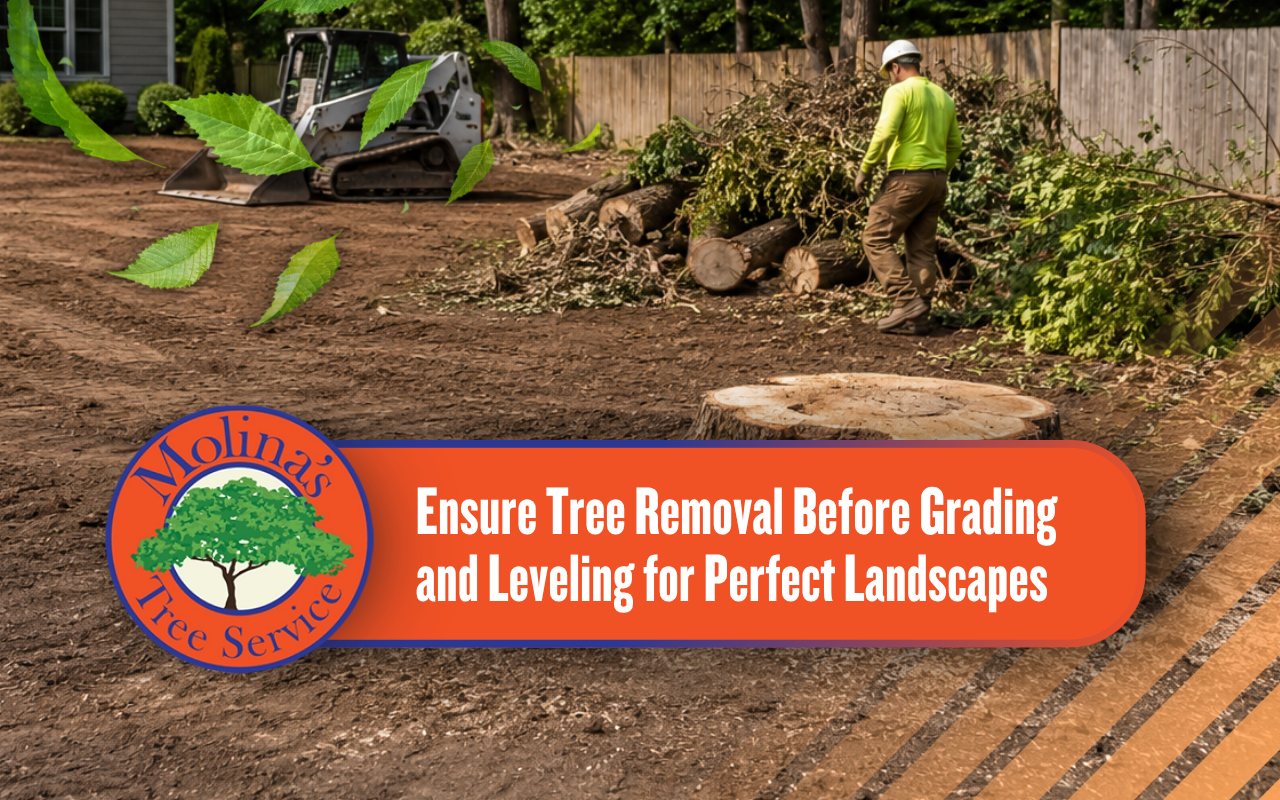
Creating a smooth, useful landscape starts before grading equipment reaches the yard. At Molina’s Tree Service & Landscaping LLC, we evaluate trees, roots, access points, and nearby features so homeowners can plan the work in the right order.
Tree Removal Before Grading and Leveling can reduce delays caused by stumps, buried roots, and unstable soil. Our professional tree removal services can help prepare the site before soil is moved, compacted, or reshaped.
Why Should Tree Evaluation Come Before Earthwork?
Every grading project changes the way soil supports plants, structures, and drainage. Trees located inside or near the work area may block equipment, limit the planned slope, or leave roots beneath sections that must be leveled. An early evaluation shows which trees can remain and which may interfere with the finished design.
This planning step also helps protect trees that are not being removed. Cutting major roots or adding deep soil around a trunk can weaken a tree. By reviewing the full project area first, we can coordinate removal, access, and grading with fewer surprises during construction.
How Trees and Roots Disrupt Yard Leveling
Large roots can raise the soil, create hard sections, and prevent grading equipment from shaping an even surface. Tree Removal Before Grading and Leveling gives crews clearer access to the soil that must be cut, filled, or compacted. It also reduces the chance of roots being uncovered halfway through the project.
Understanding how tree roots affect leveling projects is important because visible roots may represent only part of the problem. Buried roots can decay after grading and leave empty spaces below the surface. Over time, those spaces may contribute to settling, low spots, or uneven areas.
Planning Safe Tree Removal and Site Access
Removing trees before yard grading requires more than cutting trunks at ground level. Our team at Molina’s Tree Service & Landscaping LLC considers the equipment route, nearby structures, slope conditions, and the amount of root material that may need attention before grading begins.
- Mark the planned grading and leveling area.
- Identify trees, stumps, and visible surface roots.
- Check access for removal and grading equipment.
- Review nearby fences, utilities, walkways, and buildings.
- Decide how wood, branches, and debris will be handled.
Homeowners preparing a larger property can also review our guide to lot clearing and tree removal preparation. It explains how organized clearing can support later property improvements.
Choosing Removal Methods for Grading Projects
The right removal method depends on the tree’s size, location, condition, and distance from structures. Sectional removal may be useful in a tight area, while controlled felling may suit an open space. Stump grinding or root excavation may also be needed based on the depth of the planned grading work.
With Molina’s Tree Service & Landscaping LLC, homeowners can discuss the project goal before removal begins. A tree removal service should understand where the grade will change, how deep soil work may go, and whether the area will support a lawn, patio, planting bed, or expanded yard.
For projects connected to construction changes, our tree removal planning guide for home renovations offers additional preparation ideas.
Preparing Soil After Trees and Stumps Are Gone
Tree Removal Before Grading and Leveling does not end when the trunk is removed. Stumps, roots, loose wood, and disturbed soil must be reviewed before grading starts. The next steps depend on the future use of the area and the amount of soil that will be moved.
- Remove loose branches, wood pieces, and surface debris.
- Grind or remove stumps that conflict with the planned grade.
- Address large roots inside the main work area.
- Fill deep holes with suitable soil in controlled layers.
- Check the surface before grading equipment enters the site.
Careful cleanup gives the grading crew a more consistent working surface. It can also make it easier to identify soft soil, hidden depressions, or areas that may need additional preparation before final leveling and compaction.
Drainage, Expansion, and Long-Term Yard Stability
Grading should guide water away from foundations, walkways, and other areas where pooling may cause problems. Remaining roots, stump cavities, and poorly filled holes can interrupt that slope. Removing these obstacles early supports a more predictable surface and a cleaner drainage plan.
Tree removal may also create room for a larger lawn, recreation area, garden, or outdoor living space. Homeowners considering more usable space can explore our backyard expansion planning guide.
- Confirm where water should flow after grading.
- Keep the new slope directed away from important structures.
- Compact filled areas in layers to reduce settling.
- Leave enough space for future planting and maintenance.
- Choose new trees with mature root growth in mind.
Frequently Asked Questions
Should every tree be removed before grading?
No. Trees outside the work area may remain when their roots, trunks, and canopies will not conflict with equipment or the planned slope. At Molina’s Tree Service & Landscaping LLC, we focus on the project area and the conditions around each tree. Our tree and landscaping service options can support broader site planning.
Can grading equipment remove tree roots?
Grading equipment may expose or break roots, but that does not make it the best removal method. Large roots can slow the work, damage equipment, or leave uneven soil. A planned tree removal service for site preparation can address these obstacles before grading begins.
What happens if roots remain under leveled soil?
Roots left beneath the surface may decay and create spaces in the soil. Those spaces can contribute to settling, dips, or changes in drainage. The risk depends on root size, soil conditions, compaction, and how the finished area will be used.
When should tree removal be scheduled?
Tree removal should be scheduled after the site plan is clear but before grading, leveling, or major soil delivery. This order gives removal crews room to work and helps prevent newly graded areas from being disturbed. Homeowners can use our tree removal project planning guide to organize the sequence.
Do I need to remove the entire stump?
The answer depends on the final grade and intended use of the area. Grinding may be enough for some projects, while deeper removal may be needed where soil will be cut, utilities will be placed, or a hard surface will be built.
Plan a Cleaner Start for Your Landscape
Tree Removal Before Grading and Leveling gives homeowners a clearer path from site preparation to the finished landscape. When trees, roots, access, soil, and drainage are reviewed together, the project can move forward with fewer hidden obstacles and a more stable base.
When you choose Molina’s Tree Service & Landscaping LLC, we can discuss how tree removal fits into your grading or leveling plan. Review our available tree and landscaping services, then contact our team about your site preparation needs.