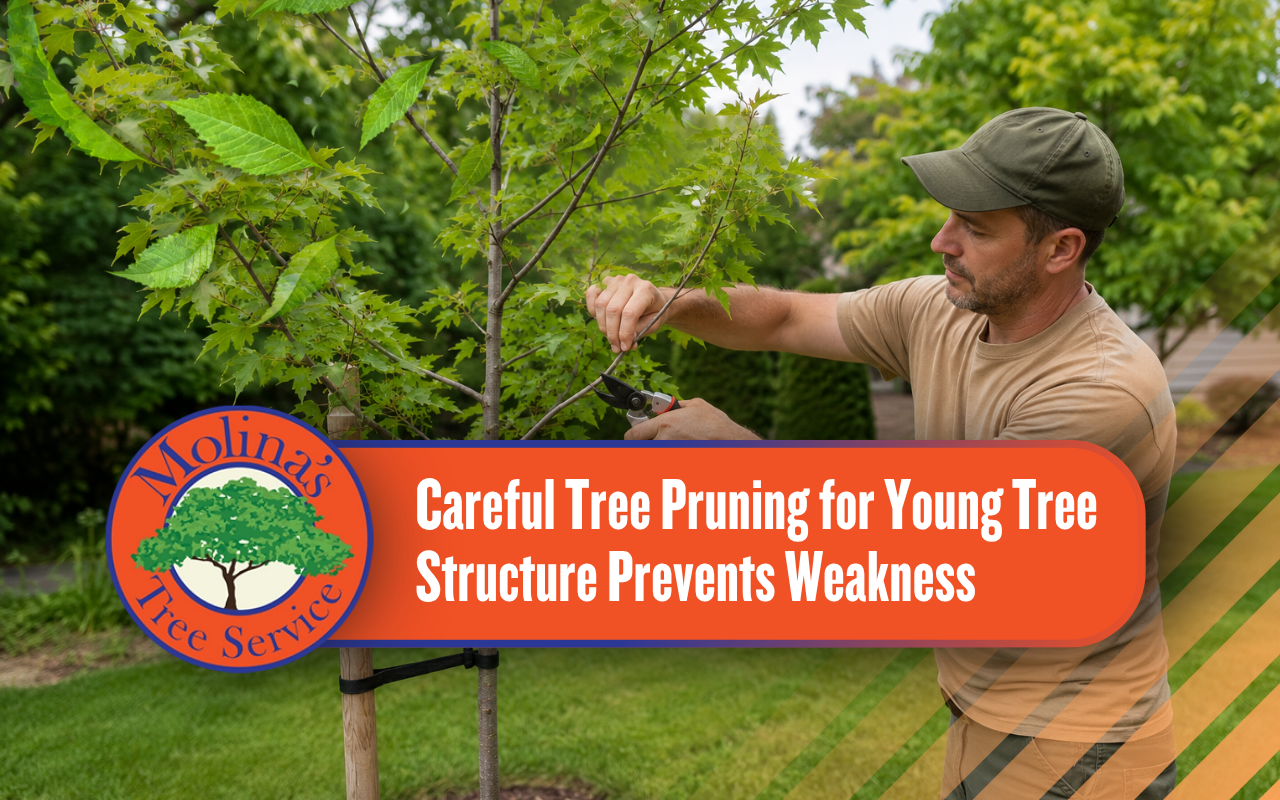
Tree pruning for young tree structure guides new growth before weak limbs become lasting problems. Early care supports a balanced shape, stronger branch angles, and a healthier canopy. At Molina’s Tree Service & Landscaping LLC, we help homeowners make careful choices that protect each tree’s natural form.
Young trees respond best to small, planned cuts. Therefore, shaping them early can reduce future damage, improve appearance, and make ongoing care easier. The goal is not to remove many branches. Instead, each cut should support steady growth and long-term strength.
Tree Pruning for Young Tree Structure Supports Growth
Tree pruning for young tree structure creates a solid framework while branches are still small. A clear main stem and well-spaced side branches help the tree handle wind, rain, and future weight. Good spacing also lets more light and air move through the canopy.
- Remove crossing or rubbing branches.
- Keep one healthy main leader.
- Favor branches with wide, strong angles.
- Leave enough foliage to support growth.
Healthy Branch Spacing Supports Balance and Lasting Stability
Good branch spacing lowers the chance of splitting as the tree grows. Branches that start too close together may compete for room and create weak joints. In contrast, evenly placed limbs form a stronger shape and make later pruning simpler.
Our team also checks how each branch connects to the trunk. Wide branch angles are usually safer than narrow ones. This basic step supports stable growth without forcing the tree into an unnatural form.
Proper Timing Reduces Stress During Young Tree Pruning
Late winter or early spring is often a good time for routine shaping because many trees are still dormant. During this period, cuts are easier to see, and the tree can begin healing as new growth starts. However, dead or broken limbs may need faster attention.
At Molina’s Tree Service & Landscaping LLC, we also consider the tree species, weather, and current condition before pruning. For more detail, read our guide to pruning for better health and structure.
Correct Cuts Protect Bark and Encourage Clean Healing
Knowing how to shape young trees correctly begins with clean cuts near the branch collar. Cutting too close can damage the trunk, while leaving a long stub may slow healing. Sharp tools also reduce tearing and create a smoother wound.
- Choose the branch that needs removal.
- Find the raised branch collar.
- Cut just outside that area.
- Use three cuts for heavier limbs.
For related guidance, review our explanation of tree thinning compared with topping.
Common Pruning Errors Can Weaken Developing Tree Structure
Common pruning mistakes on young trees include removing too much foliage, topping the main stem, and making flush cuts against the trunk. These actions may cause weak shoots, slow recovery, or future decay. Careful pruning should improve structure without shocking the tree.
- Do not remove large amounts at once.
- Avoid cuts that leave rough bark tears.
- Never top a healthy young tree.
- Do not prune only for quick appearance.
Our article about pruning and disease prevention explains why clean, limited cuts matter.
Simple Tools Make Young Tree Care More Effective
Small branches usually need hand pruners, while thicker limbs may require loppers or a pruning saw. Tools should be sharp, clean, and comfortable to control. Dull blades can crush wood and leave uneven cuts that take longer to close.
A professional tree pruning service also uses safety gear and the right cutting method for each branch. With Molina’s Tree Service & Landscaping LLC, you receive clear guidance before work begins. You can also review our tree trimming service options.
Frequently Asked Questions
When should a newly planted tree first be pruned?
Start by removing dead, broken, or badly placed branches. Major shaping can often wait until the tree begins to settle and show steady growth.
How much growth should be removed at once?
Only remove what is needed for safety and structure. Taking too much foliage can reduce energy and slow healthy development.
Can pruning help a young tree grow straighter?
Yes. Tree pruning for young tree structure can reduce competing leaders and guide the strongest stem upward without forcing a rigid shape.
What branches should remain on a young tree?
Keep healthy branches with good spacing, wide angles, and room to grow. These limbs will support the future canopy.
When is professional pruning support the better choice?
Professional help is useful when branches are high, cuts are unclear, or the tree has several structural problems. A trained team can reduce risk and protect healthy growth.
Consistent Care Shapes Safer and More Beautiful Trees
Tree pruning for young tree structure works best as a gradual process. Regular checks help catch weak growth early, while light corrections protect the tree’s natural shape. Watering, mulch, and proper soil care also support recovery after pruning.
When customers contact Molina’s Tree Service & Landscaping LLC, we explain how to shape young trees correctly and avoid common pruning mistakes on young trees. Visit our tree shaping guide for homeowners, or contact our team for pruning guidance.